Morning buns
- Received, 4 weeks
- 246
- Sold, 4 weeks
- 182
Inventory
How to decide your cafe's Saturday pastry order
Mark, founder of Parly5 min read
Here's how to decide your Saturday pastry order: take the last four Saturdays, compare what came in against what sold, and set the order to the sell-through you want. Then change the standing order before the bakery's notice window closes.
It is 3 PM on a Saturday. The muffins went at noon and half a tray of morning buns is still in the case. Both of those are the standing order talking, and both are fixable before next Saturday.
Four Saturdays, received against sold
Sell-through is what sold divided by what came in. A pastry that came in 12 times and sold 9 times sold through at 75 percent; the other three went home with someone or in the bin.
Use four Saturdays, not one. One Saturday can be rain, a street fair or a closed road. Four start to show you the day. Write down, for each pastry, what the bakery delivered and what Square says you sold, and add each column up.
Here is the same read at Cafe Parly, our example cafe, over four weeks of every day. Its deliveries are filled in from the standing order rather than counted at the door, so its received column is what was ordered.
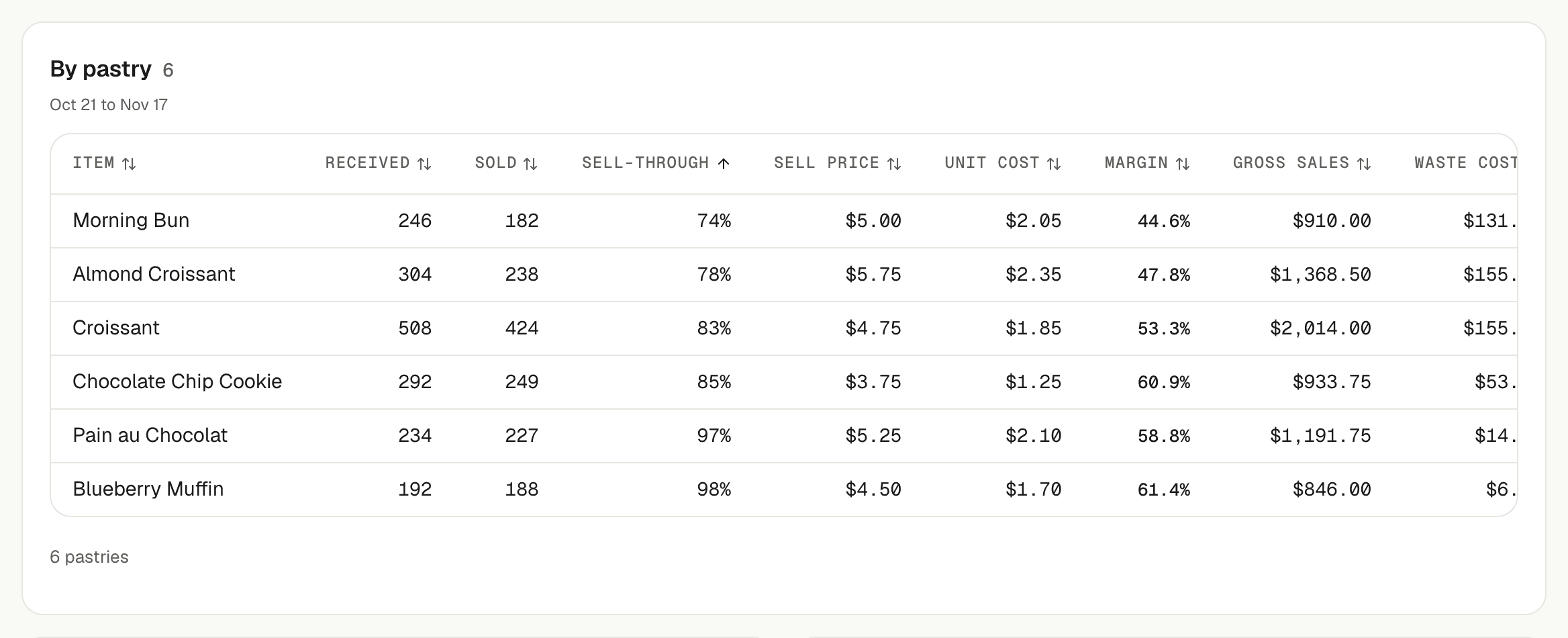
The spread is the point. The morning bun sold 182 of 246, 74 percent. The blueberry muffin sold 188 of 192, 98 percent. Same bakery, same case, and opposite problems: one is ordered too deep, and the other may be selling out before close, which no report can show you because the sale never happened. The same report also lays sell-through out by weekday, which is where the Saturday answer lives.
Pick the sell-through line you can live with
There is no right sell-through. It is a choice between two costs you can name: what you bin, and the sale you never made because the case was empty.
Here is what each line cost Cafe Parly over the four weeks (Example), at the bakery's price for each pastry:
| Pastry | Received | Sold | Sell-through | Left over | Cost of what was left |
|---|---|---|---|---|---|
| Morning bun | 246 | 182 | 74% | 64 | $131 |
| Almond croissant | 304 | 238 | 78% | 66 | $155 |
| Croissant | 508 | 424 | 83% | 84 | $155 |
| Chocolate chip cookie | 292 | 249 | 85% | 43 | $54 |
| Pain au chocolat | 234 | 227 | 97% | 7 | $15 |
| Blueberry muffin | 192 | 188 | 98% | 4 | $7 |
The two croissants account for $311 of the $517 left over in four weeks. The plain croissant gets there on volume, as the biggest order in the case. The almond croissant gets there with fewer left, because each one costs $2.35 from the bakery against $1.85.
At 74 percent, Cafe Parly's morning buns left 64 over four weeks, $131 at the bakery's $2.05 each. If it took one fewer bun a day and still sold 182, the leftover cost would fall to about $74 and sell-through would rise to 83 percent. At 98 percent, the muffin leaves almost nothing, but nobody records the customer who wanted one at 1 PM.
Parly's suggestions start from a 75 percent line. That is a starting point, not a number cafes are known to hit. Set your own:
- Your best seller can run lower, because selling out of it costs you more than one in the bin.
- A pastry people only buy on impulse can run higher, because a missing cookie is easy to swap for something else in the case.
- Write the line down per pastry, so the next order is a comparison and not a mood.
Set each weekday on its own
A standing order that is the same seven days a week is a weekday order you also get on Saturday. Cafe Parly's grid is different every day: 50 pastries on a Tuesday and 89 on a Saturday, with croissants going from 14 to 25.
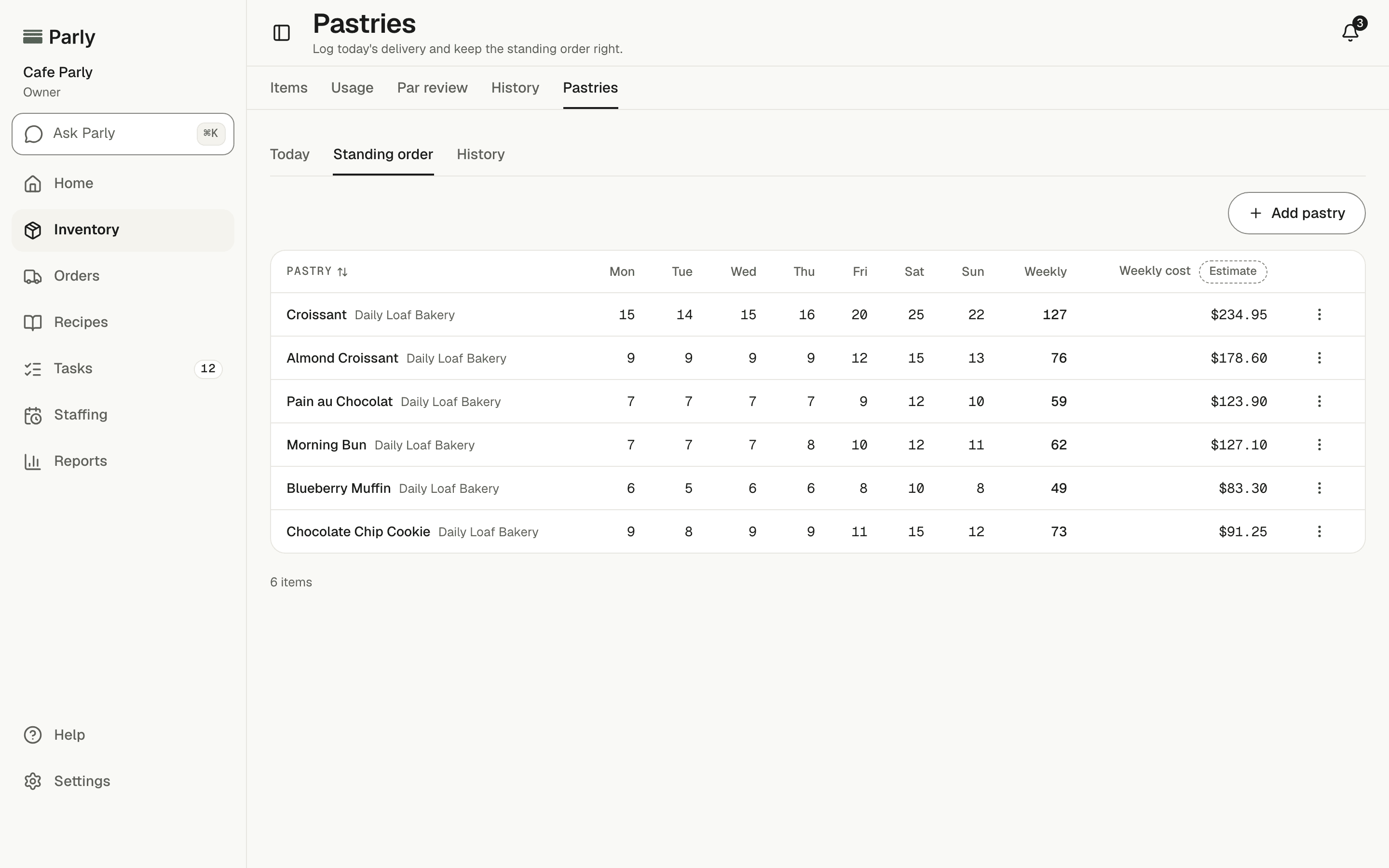
A quick test for your own grid: divide Saturday's order by Tuesday's. Cafe Parly's comes out at 1.78. If yours is close to 1 and your Saturday sales are not, the standing order was set for a weekday and never moved.
Set Saturday from Saturdays, and Tuesday from Tuesdays. The sales side of this is the same weekday logic as reading your sales by day of the week: your Saturday is a different shop from your Tuesday, so it gets its own order.
Change the standing order before the notice window
The bakery's clock decides when your change counts. Cafe Parly's bakery, Daily Loaf, delivers every morning before open and takes changes with a day's notice, by noon. So a change to Saturday's order has to be in by noon on Friday, or Saturday comes in the same as last week.
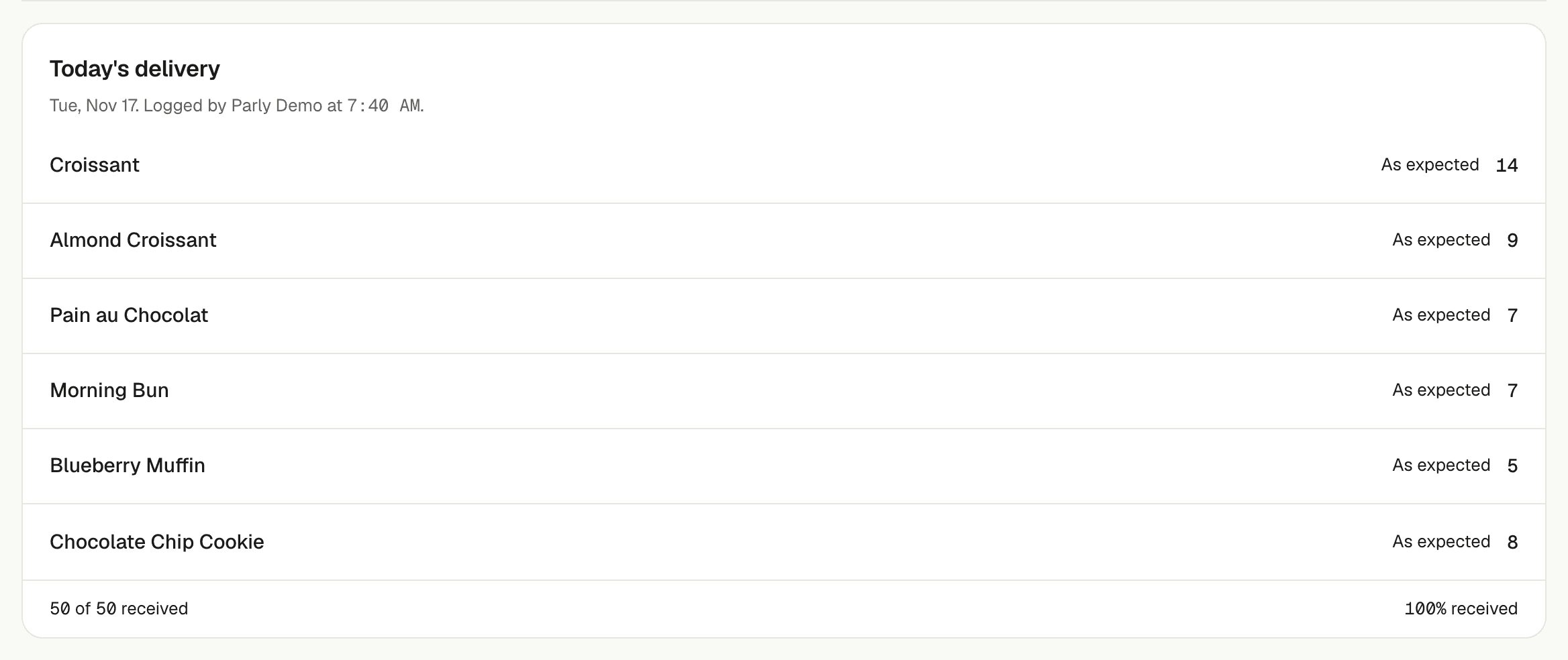
Put the change in when you decide it, not when you remember it. A standing order nobody touches is how a pastry runs at 74 percent for a month. Every other supplier runs on a clock too, and never missing a supplier cutoff covers the rest of them.
Run your Saturday numbers this week
- Pull the last four Saturdays' pastry sales from Square, by item.
- Write what the bakery delivered on each of those Saturdays next to them.
- Work out sell-through per pastry: sold divided by received.
- Pick a line for each pastry, then move each Saturday quantity toward it by one or two at a time.
- Send the change before the bakery's notice window closes, and check the next four Saturdays the same way.
The pastry order calculator below does the math for steps 3 and 4: put in your four Saturdays and it shows each pastry's sell-through, the cost of what was left and a suggested standing order.
Free toolPastry order calculator
Open the full pageFor the wider read on what ends up in the bin, see tracking cafe waste with your own data, and par levels cover everything else on the shelf.
Start with the pastry that sold through the lowest last month. Often it is one item, and one change, before Friday noon.
New guides like this one by email, about once a month.