Inventory
How to stop running out of oat milk at your cafe
Mark, founder of Parly5 min read
Note
The short answer
To stop running out of oat milk at your coffee shop, count it from your modifier sales instead of your gut, because in Square an oat swap is a modifier and modifiers never touch inventory. Then set its par deeper than your dairy par: a sealed shelf-stable carton keeps for months, so oat can carry a bigger cushion on a slower order rhythm. Parly reads every Square ticket, swaps included, shows you what oat each day actually used, and turns your count into the supplier's order before its cutoff.
Why oat runs out when whole milk does not
It is 11:15 on a Saturday and the last carton of oat is open on the bar. The whole milk fridge is fine. It always is.
The difference is not your team or your supplier. It is where each milk lives in your register. Whole milk is usually the recipe default, so every latte that sells is a latte that used whole milk. Oat is almost always a modifier, "Oat milk" riding on the ticket, and by Square's own documentation modifiers don't track inventory or costs (Square Recipes support page, accessed 2026-11-23). So the oat that leaves your shelf with every swap shows up nowhere until someone counts.
That leaves you ordering oat off the shelf as it looked last Monday, while the swaps keep pulling from it all week. On a slow week you get away with it. On the week the weather turns and iced oat lattes double, you find out at 11:15. I covered what that gap did to my own oat order when the modifiers went dark in our numbers; the short version is that the order was wrong by a factor of three.
Find your real oat use from the modifier report
Square already records every swap. It just files it under sales, not stock.
- In your Square Dashboard, open Reports > Sales > Modifier sales (Square support, accessed 2026-11-23).
- Set the date range to the last two full weeks and find your oat modifier. If it was renamed at some point, Square lists the old name as a separate entry, so add both.
- Split the swaps by drink size if you can, because a 16 oz iced latte pours more oat than an 8 oz flat white. If your sizes are variations, pull item sales for the oat-heavy drinks alongside.
- Multiply each size's swaps by the ounces you pour for it, add them up, and divide by the number of days.
- Add the drinks where oat is the recipe default, if you have any. Those come off item sales, not the modifier report.
Say two weeks show 280 oat swaps, mostly 12 oz drinks at about 8 oz of oat each. That is 2,240 oz, or 160 oz a day, about two and a half 64 oz cartons a day. Your numbers will differ; the point is that this figure exists in your Square today and almost nobody reads it.
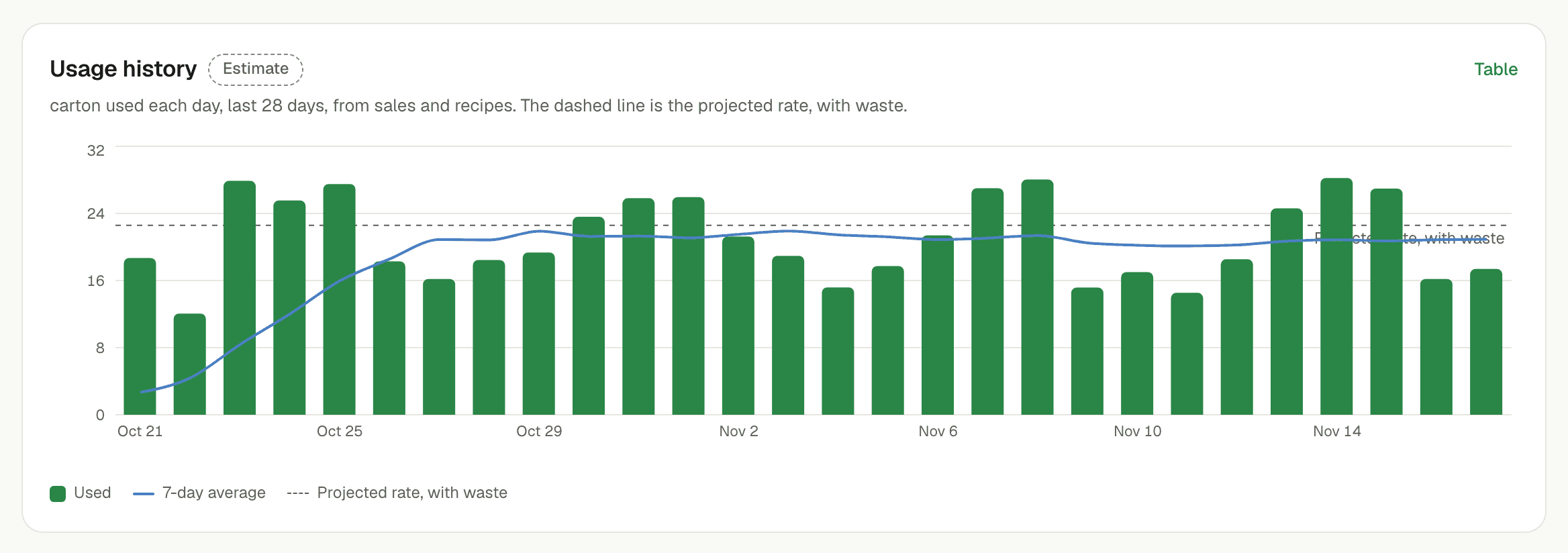
Check it against your shelf once. Count oat on Monday and again on Wednesday, add what was delivered in between, and compare the drop with what the modifier report says you poured. If the shelf went down faster, you have waste or a pour that is heavier than the recipe says. If it went down slower, someone is ringing oat drinks without the modifier.
Set the oat par for a carton that keeps
Par is the count that triggers an order: daily use times the days until the next delivery lands, plus a cushion for your busiest day. That formula is the same for every item (how to calculate par levels walks through it). What changes for oat is the cushion.
Dairy lives on a short date in the fridge, so a dairy par is tight on purpose. Oat in a shelf-stable carton does not. Oatly says its ambient carton keeps "for almost a year if unopened" (Oatly, accessed 2026-11-23), and Califia says its barista cartons can sit unrefrigerated before opening (Califia Farms FAQ, accessed 2026-11-23). Once opened, both say refrigerate it and use it within about a week.
| Dairy whole milk | Shelf-stable oat | |
|---|---|---|
| Sealed life | until its date, in the fridge | months, on a shelf |
| Where usage shows in Square | the recipe default | a modifier, invisible to stock |
| Right cushion | tight, a day at most | generous, several days |
| Cost of over-ordering | poured out | shelf space and cash, no spoilage |
| Cost of under-ordering | a retail run | a retail run and a Saturday of "sorry, no oat" |
So give oat a cushion of several days, not one. If you go through two and a half cartons a day and your oat supplier delivers twice a week, a par of 10 to 12 cartons with an order up to the next delivery after is ordinary, where the same logic on dairy would leave milk to sour.
Warning
Check your carton first
Free toolMilk order calculator
Open the full pageOrder it on its own rhythm, not the dairy rhythm
Oat often does not come from your dairy. Check which supplier carries it; plenty of cafes buy alt milks from a dry goods or paper distributor with its own cutoff and delivery days. Put oat on that supplier's order day, not on the dairy run, and size it to reach the delivery after next.
Because the carton keeps, you can afford to order oat less often and in bigger drops. That frees the daily dairy order to stay small and exact, which is where the money leaks if you overdo it. The supplier ordering schedule puts every supplier's window on one card so oat gets its own line.
What to check on your next count
One line, every count day: is the oat number dropping the way the swaps say it should? If the shelf and the modifier report agree, your par is set and the order will look after itself. If they do not, find out why before you raise the par, because a bigger par on a miscounted item just stacks cash on the shelf.
If you charge for the swap, this is also the moment to check the upcharge covers the extra milk. Should your cafe charge for oat milk costs it out drink by drink.
New guides like this one by email, about once a month.