What last week left
- Net sales, one week
- $16,054
Sales & Costs
What your cafe made last week vs what Square shows
Mark, founder of Parly5 min read
Here's how to work out what your cafe really made last week. Start from Square's net sales, take off what the drinks used and what you paid the team, then take off the two costs net sales still has in it, and say out loud what the number still leaves out. It is never the number Square shows you.
Sunday night, the week is closed, and the Square app shows a number that looks like a good week. That is not what landed in the account, and it is rare to sit down and walk from one to the other. Here is the walk, one line at a time.
Start from net sales, and know what Square already took out
Square's sales summary walks down from gross sales. Gross is everything rung up. Take off discounts, comps and refunds and you get net sales, which is the line to start from.
Two things sit outside net sales and are never yours: the sales tax you collected, which goes to the state, and the tips, which go to the team. If your bank deposit looks bigger than net sales, those two are usually why.
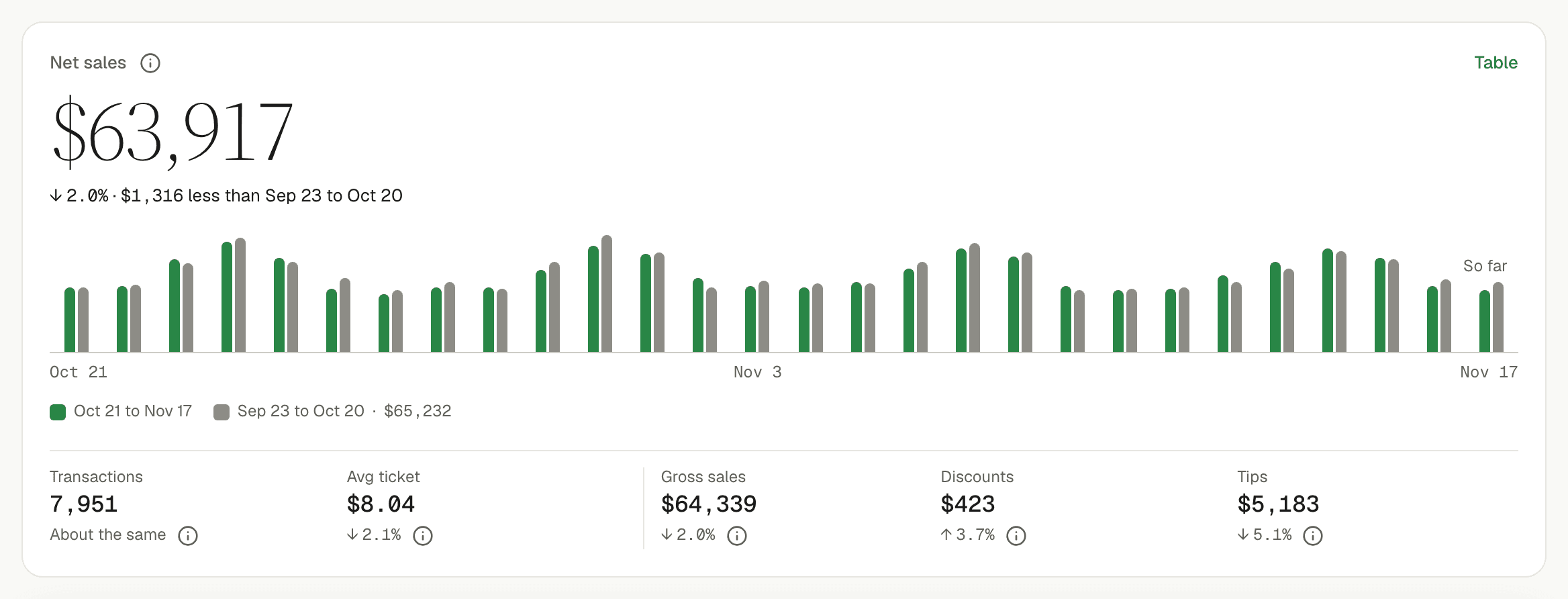
The week we will walk is Cafe Parly's, our example cafe, for one week in November: $16,054 in net sales over 2,027 transactions.
Take off what last week's drinks used
Every drink took espresso, milk, syrup, a cup and a lid. Add up what those cost for every drink you sold, modifiers included, and you have what the week's sales used. You need a recipe for each item to do it. Without recipes this line is a guess, and food cost percentage is the same number as a share of sales.
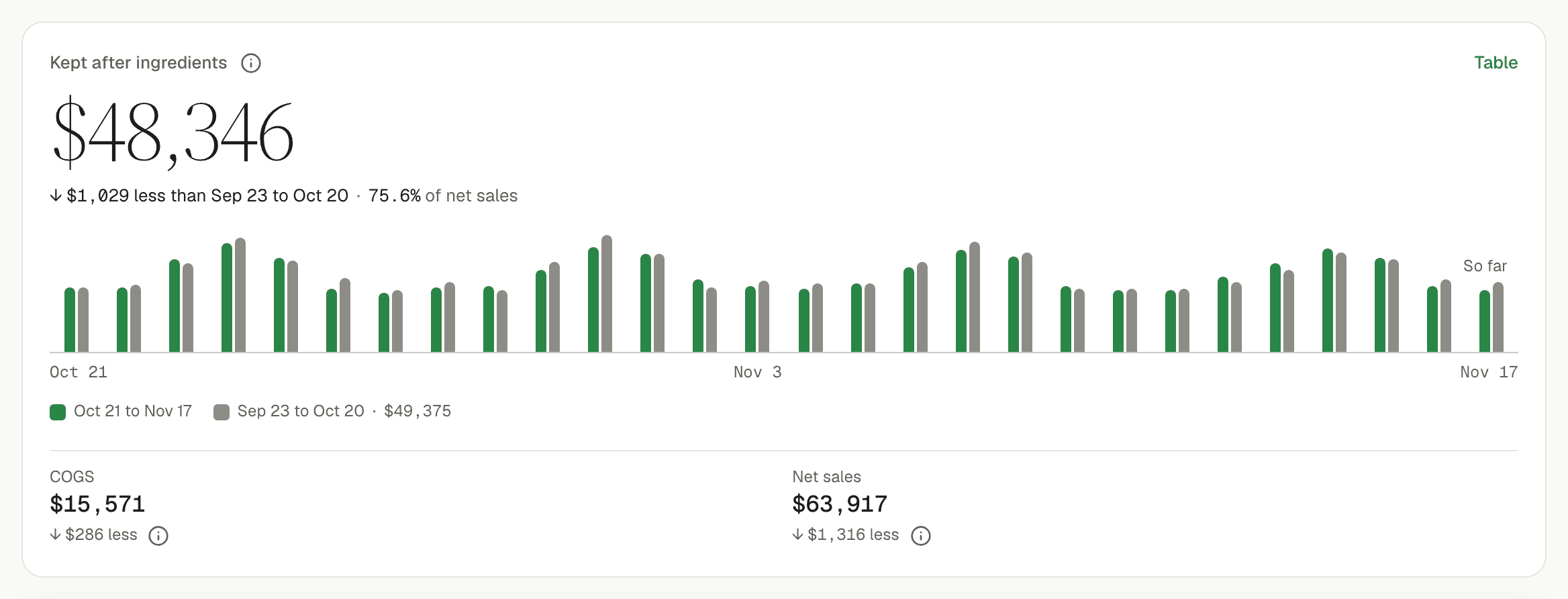
At Cafe Parly, the recipes say the week kept 75.7 percent of its costed sales after ingredients, cups and lids, so the drinks and pastries used about $3,901. That figure is an estimate in the app and here, because it is only as complete as the recipes: any item without one is left out of the cost.
Take off what you paid the team
Wages come off next, from the timecards, not the schedule. Card tips stay out of this line, because they were never in net sales to begin with.
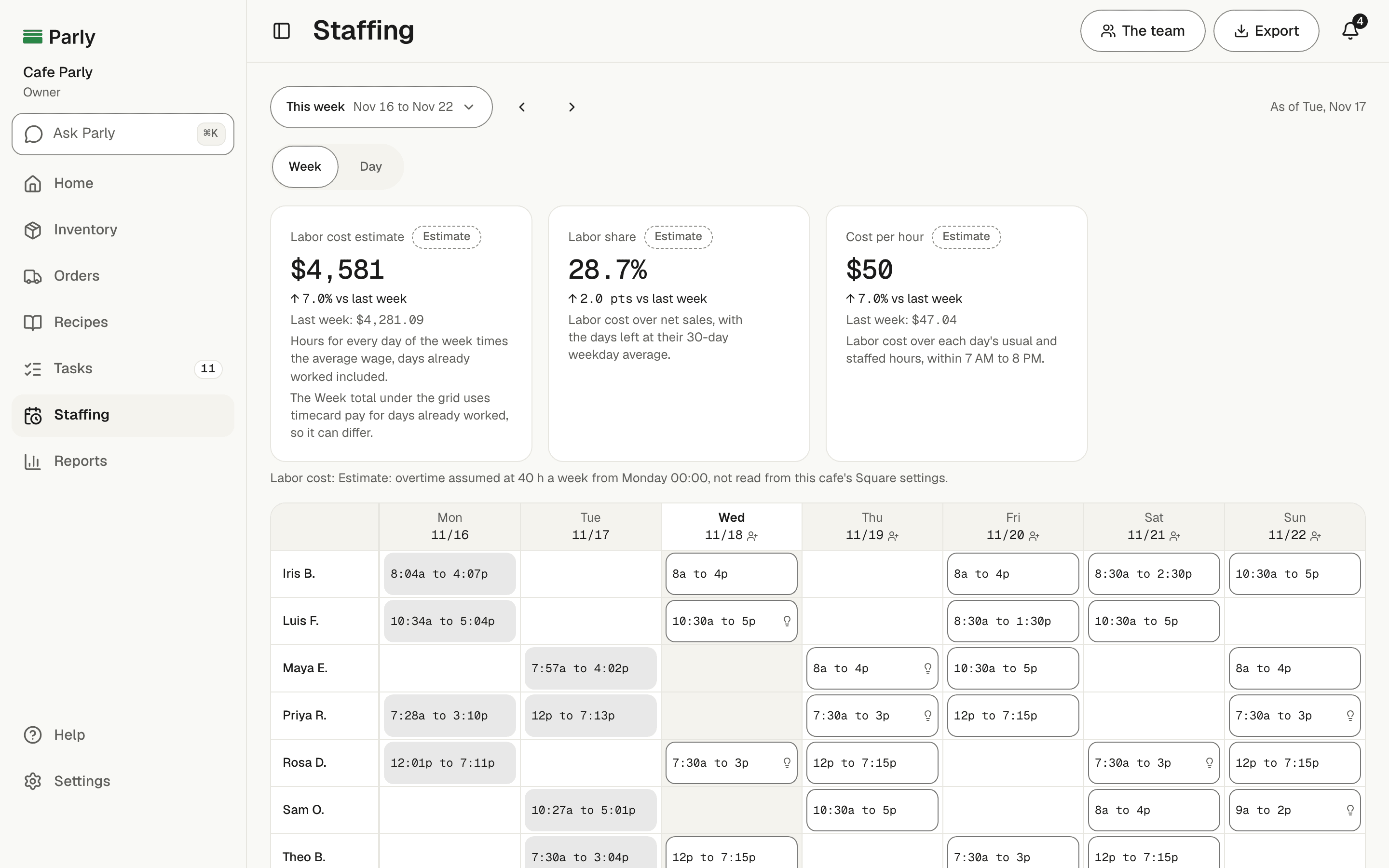
Cafe Parly paid about $4,281 in wages that week, 26.7 percent of net sales. The app labels it an estimate, worked from timecard hours at the average wage. If you want to know whether that share is high, your labor cost percentage works through what profitable counter-service shops run.
Then the two costs net sales leaves in: card fees and rent
This is your own math, and neither line is a Parly screen. Card fees sit in Square's own summary, apart from the sales lines, and rent sits in no report at all.
Card fees. Square's published US rate for in-person card payments on its Free plan is 2.6 percent plus 15 cents a payment (Square, Our fees, accessed November 2026; the Plus and Premium plans charge less). If every one of Cafe Parly's 2,027 transactions that week was a card tap, the fees on net sales alone come to about $721. The real figure differs: fees are charged on tax and tips too, which pushes it up, and every cash sale pulls it down. Square's sales summary shows the fees you actually paid, and what Square's card fees really cost a coffee shop shows why the 15 cents is most of them.
Rent. Nobody can give you this but your lease. Take the month's rent, divide by the days in the month, and multiply by seven.
Here is the week laid out, with where each line comes from:
| Last week at Cafe Parly | Dollars | Where it comes from |
|---|---|---|
| Net sales | $16,054 | Square sales (Example) |
| What the drinks used | $3,901 | Recipes times what sold (Example, Estimate) |
| What the team was paid | $4,281 | Square timecards (Example, Estimate) |
| Employer Social Security and Medicare, 7.65% of wages | $328 | IRS rate on the wages (Estimate) |
| Card fees at 2.6% plus 15 cents | $721 | Square's published rate (Estimate) |
| Rent for the week | your number | Your lease |
| Left before rent and everything below | $6,823 | Net sales minus the four lines above |
The 7.65 percent is the employer share of Social Security and Medicare (IRS Topic 751, accessed November 2026). The $6,823 is not what the cafe made. It is what was left to pay rent and everything in the next section.
Say what the number still leaves out
Any figure you call "made" should name what it skips. This one skips:
- State payroll taxes and benefits: unemployment insurance, any state leave program, workers' comp, health cover.
- Insurance, utilities and the phone line, which arrive monthly and are easy to forget in a weekly read.
- Supplies that are not on a recipe: cleaning, paper towels, the sanitizer, the gloves.
- Repairs and the espresso machine service.
- Your own pay. If you work the bar, the week owes you a wage before it owes you anything else.
Write those as monthly numbers once, divide by four and a third, and keep them on the same sheet, so each week's read starts with them already filled in. The arithmetic behind cafe closures starts with lines like these.
Do it for last week tonight
- Open Square and write down last week's net sales.
- Take off what the week's drinks used: from your recipes if you have them, from your invoices if you do not.
- Take off last week's timecard wages, tips left out, and 7.65 percent of them.
- Take off the week's card fees from Square's sales summary, and a week of rent.
- Write down what is left, and under it, the list of what it still leaves out.
The weekly take-home calculator below walks the same five steps with your own numbers, and lists what the result leaves out under it.
Free toolWeekly take-home calculator
Open the full pageThe same costs also give you the tickets a day it takes to cover them, a number you can hold against tomorrow's Square: coffee shop break-even works it from this week. For a version of this you can run every day, the daily report needs four numbers, and five reports to read every week covers the rest of the Monday read.
Do last week tonight, while you still remember what happened in it.
New guides like this one by email, about once a month.