
Labor share
- Timecard wages
- $17,120
- Net sales
- $63,917
Labor & Team
How to find your cafe's labor cost percentage
Mark, founder of Parly5 min read
Here's how to find your cafe's labor cost percentage: add up last week's pay from your timecards, add what you pay on top in payroll taxes and benefits, and divide by the same week's net sales. Then hold it against what profitable counter-service shops actually run, which was 30.0 percent of sales in the National Restaurant Association's 2024 numbers.
That is the whole method. The rest of this post is about the two places it goes wrong: putting a wages-only number next to a benchmark that includes benefits, and reading a month against an industry band when the week is the thing you can still change.
Last week's labor cost in one line of math
Labor cost percentage is pay, plus what you pay on top of it, divided by net sales, times 100. Three rules keep that line honest.
- Net sales, not gross. Net is what is left after discounts and refunds, before tax and tips. Gross flatters the percentage with money you never kept.
- Timecards, not the schedule. The schedule is what you planned on Sunday night. The timecards are what you paid, and the gap between the two is usually where the extra hours sit.
- Tips stay out. Card tips pass through to the team. They are not your labor cost and they are not your sales.
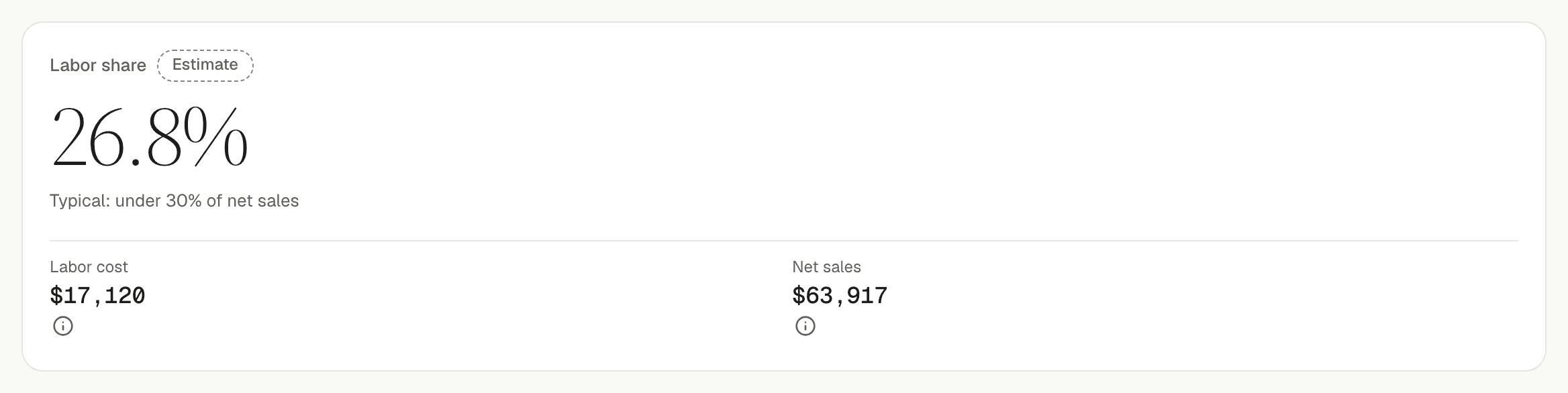
Cafe Parly, our example cafe, paid $17,120 in timecard wages against $63,917 in net sales over four weeks. That is 26.8 percent, and it is the number its Reports page shows on the Labor tab.
What the Square number leaves out
The number you can build from Square is timecard pay over net sales. Parly's Labor share is built the same way. It is a good number to watch, and it is short of your real labor cost by everything you pay on top of the wage.
One piece of that is fixed and federal. As an employer you pay 6.2 percent for Social Security and 1.45 percent for Medicare on every wage dollar, 7.65 percent in all (IRS Topic 751, accessed November 2026). The rest is yours to add: state unemployment insurance, any paid leave or disability program your state runs, workers' comp, and any health or other benefits you offer. Those differ too much from state to state and shop to shop for anyone to hand you a number.
Here is what the federal piece alone does to Cafe Parly's four weeks:
| Four weeks at Cafe Parly (Example) | Dollars | Share of net sales |
|---|---|---|
| Timecard wages | $17,120 | 26.8% |
| Employer Social Security and Medicare at 7.65% (Estimate) | $1,310 | 2.0% |
| Wages plus federal payroll tax | $18,430 | 28.8% |
Two points, before a single state tax or benefit. The gap is easy to miss, because the benchmark you hold your number against already has it built in.
What it should be: the split, not the band
Most pages give you a band with no source behind it. The best measured figure comes from the National Restaurant Association's 2025 Restaurant Operations Data Abstract, built from more than 900 operators. It puts limited-service salaries and wages, benefits included, at a median of 31.7 percent of sales in 2024 (accessed November 2026). A counter-service cafe sits in that limited-service group. Then the same report splits the median by who made money.
The split is more use than the median. Four points separate the shops that made money from the ones that lost it, and the median sits between them, so "about 32 percent" tells you nothing about which side you are on.
Parly's Labor share card carries the line "Typical: under 30% of net sales." Read it next to the split: under 30 percent is where the profitable shops sit. But the association counts benefits and the card counts wages, so compare like with like. Add your payroll taxes and benefits first, then hold the total against 30.0. Cafe Parly's 26.8 becomes 28.8 with the federal tax alone, still under the line but with far less room than the card suggests.
Read it by the week, at the same sales
A four-week percentage tells you where you stand. A week tells you what moved it, and in a cafe whose sales hold steady, what moves it is hours.
Cafe Parly's last two weeks were steady: $16,148 in net sales with labor at 26.4 percent, then $16,054 at 26.7 percent. This week's schedule is a different story. The staffing planner puts it at $4,581 in labor against last week's $4,281, up 7.0 percent, and the labor share at 28.7 percent, up 2.0 points. The planner fills the days not yet worked with each weekday's 30-day average sales, so the sales under that share barely moved. It prices every scheduled hour at the same average wage, so wage rates did not move either. The hours did it.
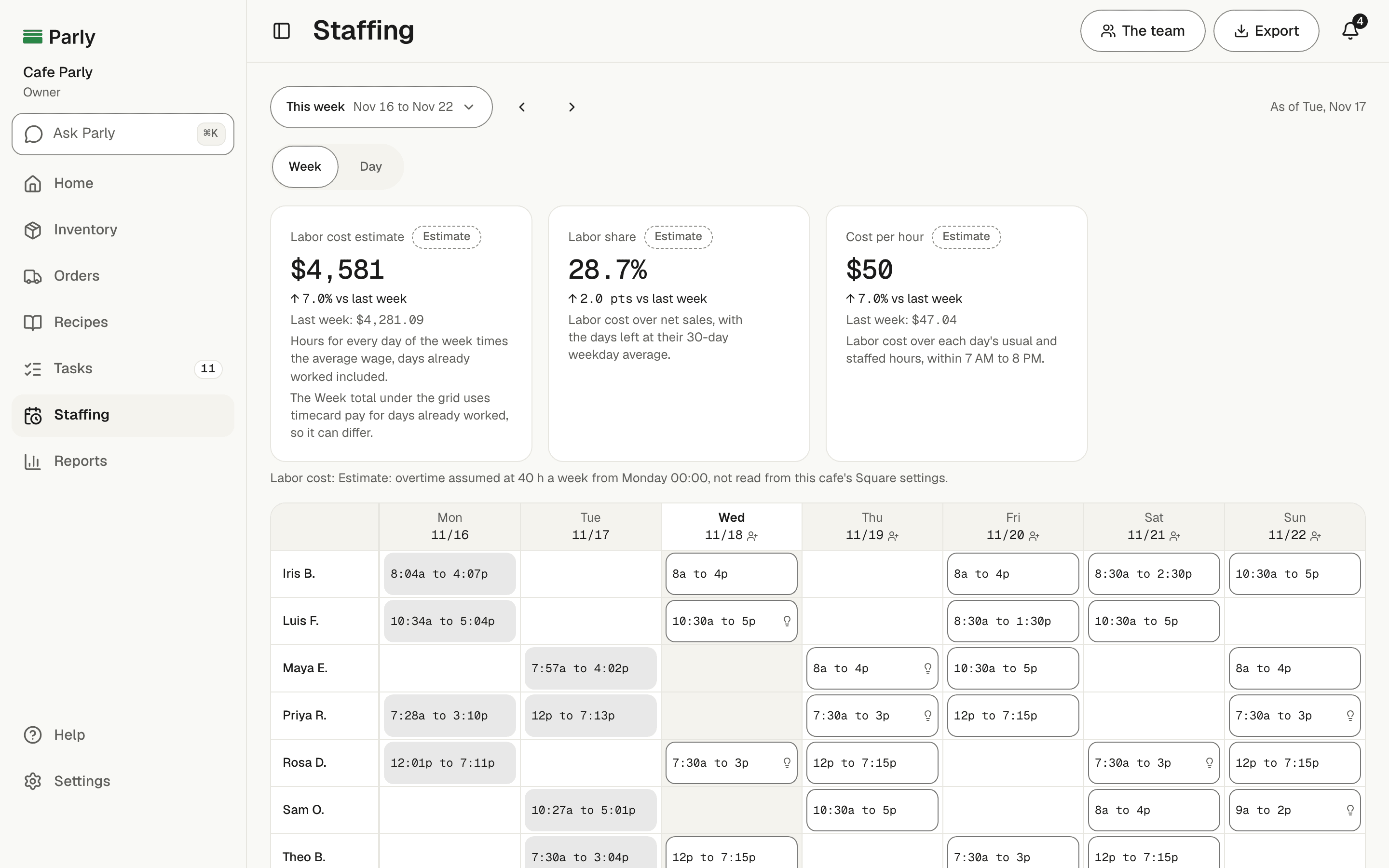
That is why the week beats the month. Nobody can change last month. You can change Thursday's close before you post the schedule.
Find the hours that moved it
Once you know the week went up, find the hours. The test for any hour is what it brought in for each person on. At Cafe Parly, the morning rush brings in $154 to $179 in gross sales an hour for each person behind the bar. From 12 PM to 3 PM, with four on, the same figure falls to $36 to $43. The busy hours are not the expensive ones. The quiet hours with a full crew are.
Two posts go deeper on the hours themselves. Revenue per labor hour works the hour-by-hour grid from your Square data, and how many baristas per shift is the check to run before you post next week.
Work out yours before Sunday's schedule
- Pull last week's net sales from Square.
- Pull the same week's timecard pay, tips left out.
- Add 7.65 percent of the pay for federal payroll tax, then your state payroll taxes and the week's share of any benefits.
- Divide by net sales and multiply by 100. That is your labor cost percentage.
- Hold it against 30.0 percent. If you are over, open next week's schedule and find the hours with the most people on and the fewest sales.
Free toolLabor cost calculator
Open the full pageThe calculator also gives you sales per labor hour for the same week, which is the number to carry into the schedule. Then look back at what the week paid in tips and wages once a month, because the percentage only tells you the share, not who earned it.
Do the five steps for last week tonight, before the new schedule goes up. If the number surprises you, better to find out on Sunday than at the end of the month.
New guides like this one by email, about once a month.