
Labor & Team
How many baristas per shift: check before you post
Mark, founder of Parly4 min read
Here's the check to run before you post next week's schedule: pull your sales by hour for the last month, lay them next to the shifts you planned, and find the hours with the most people on and the fewest sales. Your headcount answer is in those hours, not in a rule of thumb.
I used to copy last week's schedule, change two names and post it. It looked fine on paper every time. The check below takes about five minutes, and it is the difference between a schedule that matches your week and one that matches the week you had in March.
Headcount comes from your busiest hour, not a ratio
Search the question and you get "two to four baristas per shift." None of those pages says where the number came from, and none of them has seen your Saturday. There is no sourced ratio for cafes. There is your own busiest hour.
At Cafe Parly, our example cafe, the busiest hour is 9 AM: 1,434 transactions over four weeks, about 51 a day. Noon ran 703, about 25 a day. Half the tickets, and on Cafe Parly's Wednesday, twice the people on.
The question to ask of your busiest hour is whether one more person still pays their way. At Cafe Parly's 9 AM, two people on bring in $172 an hour each in gross sales, and with a third on it is still $167 each. The rush carries a third person. That is how you size the rush: by what each extra person brings in, not by a ratio.
Lay last month's sales by hour next to next week's shifts
You need two things side by side. Your sales by hour for the last four weeks, which shows when the tickets come in. And next week's planned shifts, as a grid of who is on at each hour of each day.
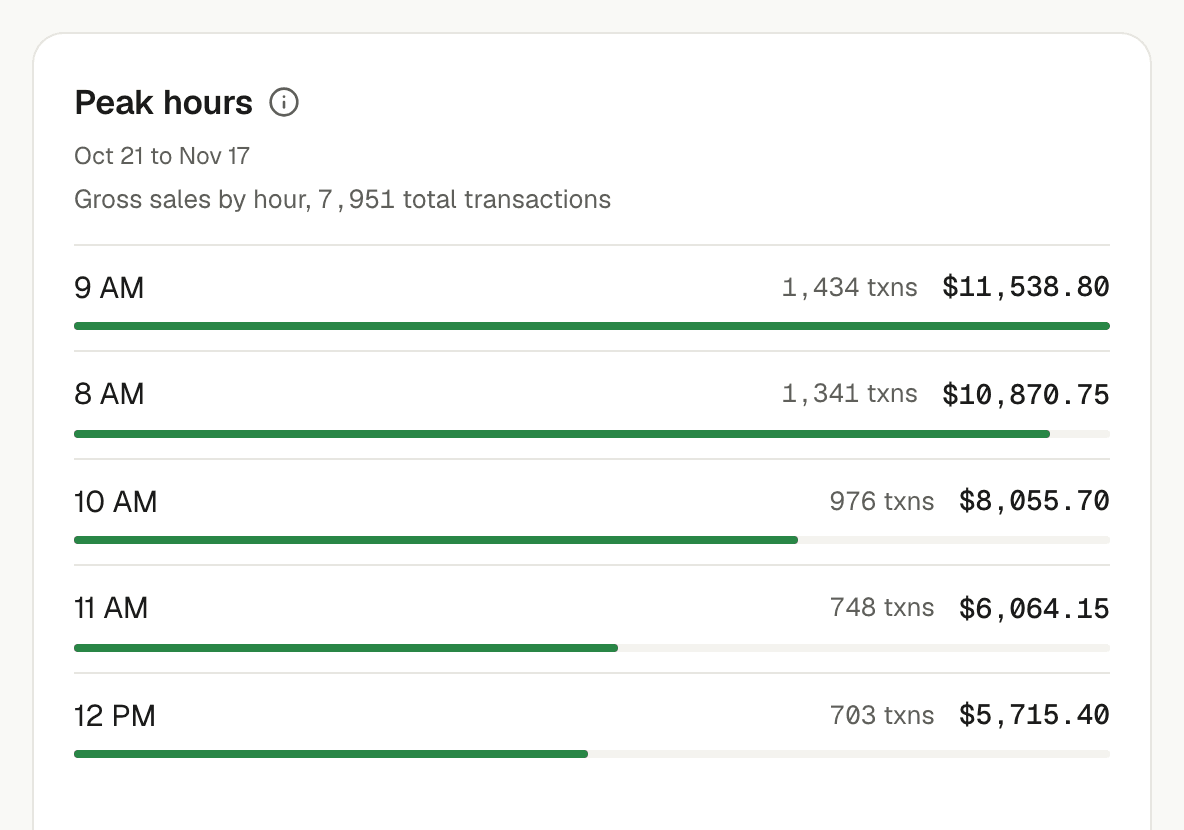
Then put the schedule beside it, a day at a time, and count heads at each hour.
Find the hours with the most people and the fewest sales
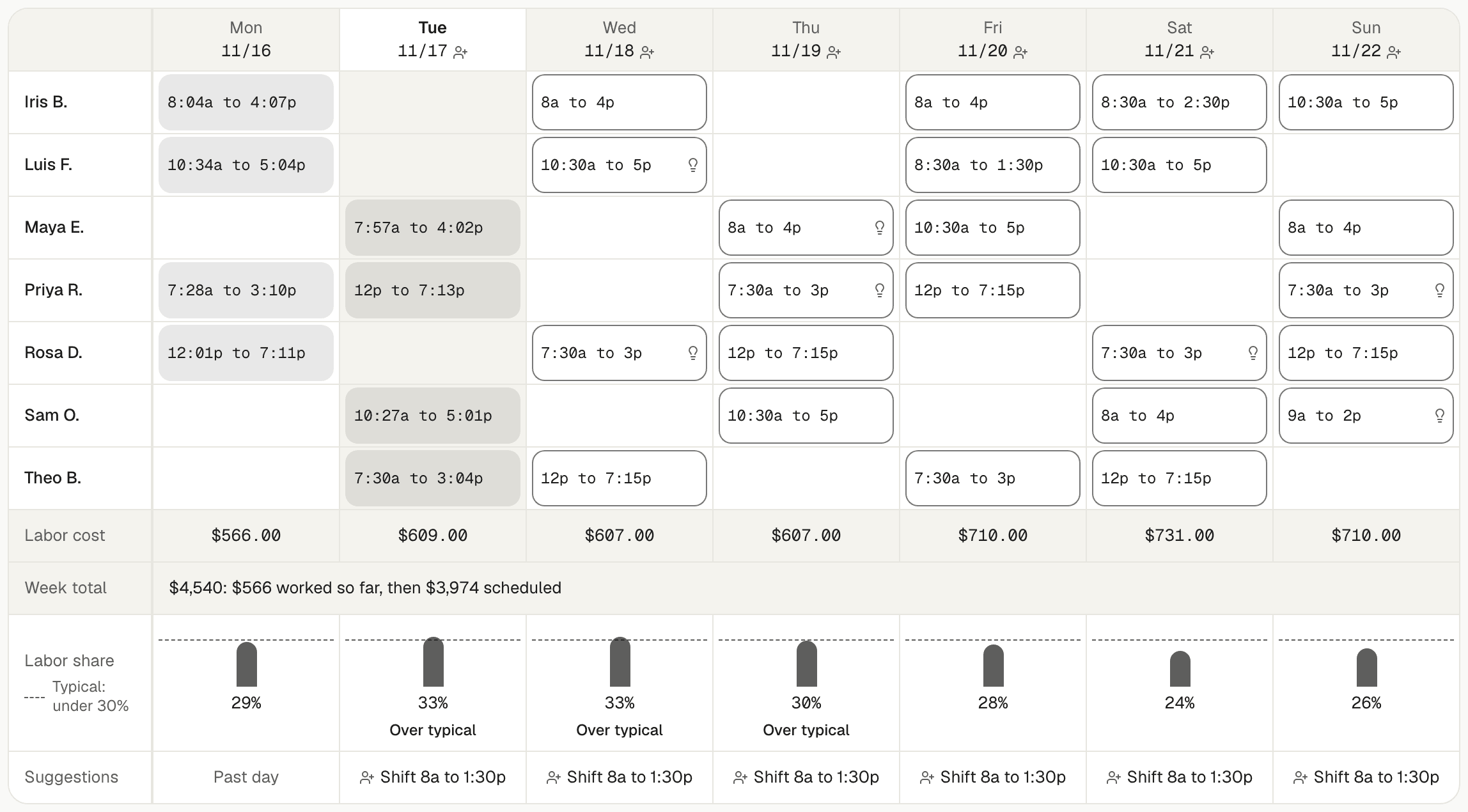
Look at Cafe Parly's Wednesday. From 12 PM to 3 PM four people are on: the opener until 3, a second opener until 4, a mid shift from 10:30 and the closer from noon. Those are the hours when the tickets have already halved.
What each person brings in shows it plainly. Across the last four weeks, with four on, Cafe Parly's 12 PM brought in $43 an hour per person, 1 PM $37 and 2 PM $36. The morning with two or three on ran four times that. Wednesday's labor share comes out at 33 percent, over the typical line, and the afternoon is the first place to look.
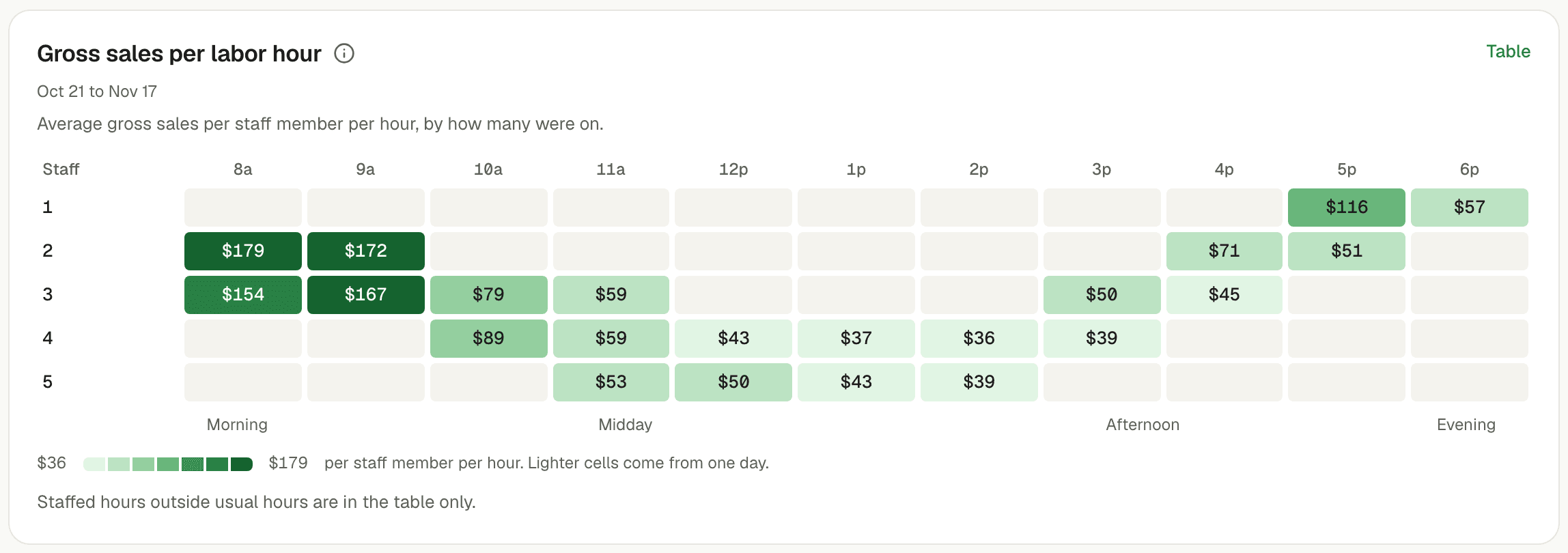
When I find this on a schedule, it is usually two shift templates that each made sense on their own, laid over the same three hours.
Then find the rush where one person makes every drink
The opposite hour hides in the same grid. On Cafe Parly's Wednesday the mid shift leaves at 5 PM, and from 5 to 6 one person is on alone, running the register and the bar.
That hour does not show up as expensive, because it is cheap. It shows up as a line at the counter, a drink remade, a closer who never got to the dishes. If your grid has an hour like that next to a four-person afternoon, the first fix to try is moving an hour, not adding one.
Price the extra hour before you add it
When an hour looks thin, put a price on the fix before you write it in. Cafe Parly's staffing planner suggests one for that Wednesday: "Extend Luis F. to 6:00 PM." It puts the cost at about $18 more in wages, against an hour that has averaged $73.00 in gross sales and about 10 transactions, "based on 4 observations over the last 30 days."
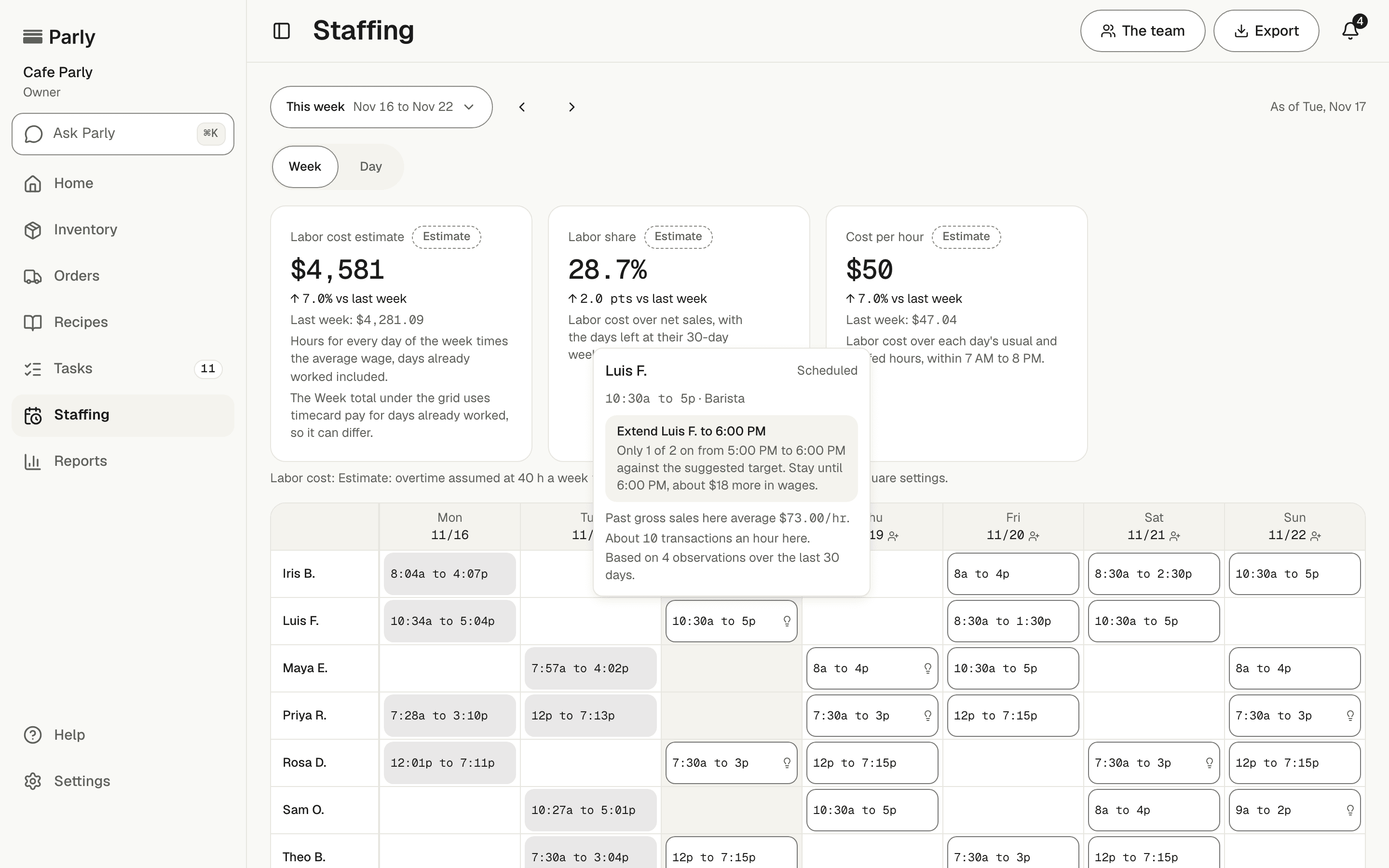
Read the basis line as carefully as the suggestion. Four Wednesdays is thin. Across every day of the same four weeks, two people at 5 PM brought in $51 an hour each, against $116 for one person alone, so on most days that hour does not carry two. The suggestion is worth having because it shows its numbers. Whether the Wednesday rush is worth $18 is your call, and you can make it with the sales in front of you.
Free toolLabor cost calculator
Open the full pageThe calculator takes a week of wages and sales and gives you the labor percent and sales per labor hour, so you can see what a moved or added hour does to both before it goes on the schedule.
The five-minute check before you post
- Open last month's sales by hour and mark your three busiest hours and your three quietest.
- Count heads at each of those hours on next week's draft schedule.
- Circle any quiet hour with more people on than your busiest hour has.
- Circle any rush hour with one person on alone.
- Move an hour from the first circle to the second before you add a new one, then post.
If the week still runs over, your labor cost percentage tells you by how much, and data-driven cafe scheduling is the full method for rebuilding the week around your sales. Scheduling against reality is what to check once the week has been worked, and turning shift chaos into confidence is about running the shift once it is staffed. The revenue per labor hour post covers the hourly grid in depth.
Run the check on Sunday, before the schedule goes out. It is five minutes against a week of shifts.
New guides like this one by email, about once a month.