
Tip pool, by hours
- Pool
- $1,445.75
- Hours
- 206.25
Labor & Team
How to split a coffee shop tip pool by hours
Mark, founder of Parly5 min read
Here's how to split a coffee shop tip pool: put the card tips and the jar into one pool, divide it by everyone's clocked hours for the same days, round each share down to the cent and carry the leftover cents into next week. The split takes five minutes. The two questions that take longer are who is allowed in the pool, and whether the card fee comes off the tips.
Sunday, 6 PM. The jar is on the back counter, Square says the week took in card tips, and seven people would like to know their share before they leave. Here is the week worked through, then the two rules that are easy to get wrong.
Put the card tips and the jar in one pool
Card tips come from Square's sales summary for the pay period. Count the jar for the same days, not the day you happen to empty it. If the jar covers Monday to Sunday and the card tips cover the 1st to the 15th, the split is wrong before you start.
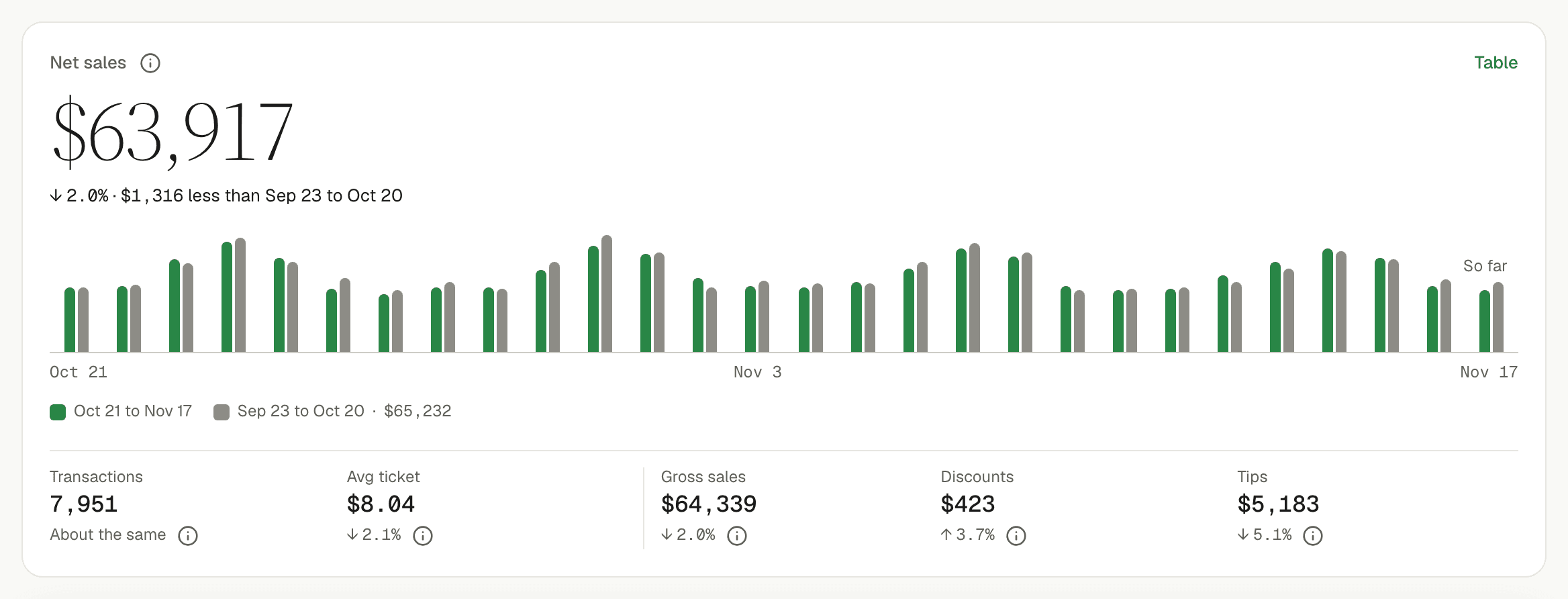
At Cafe Parly, our example cafe, Square shows $5,183 in tips over four weeks, which is $1,295.75 a week. The worked example below adds an example jar of $150, so the week's pool is $1,445.75. The seven names and their hours are examples too, built on Cafe Parly's rota.
Split by clocked hours, not the schedule
Each person's share is the pool times their hours, divided by everyone's hours. Use clocked hours from the timecards. A split on the schedule pays for the shift someone was meant to work, and the week never runs to the schedule (scheduling versus reality shows by how much).
The example week has 206.25 clocked hours, so every hour on the clock is worth $1,445.75 divided by 206.25, which is $7.01.
| Person (example) | Clocked hours | Share |
|---|---|---|
| Rosa | 34.5 | $241.83 |
| Theo | 32 | $224.31 |
| Priya | 30.25 | $212.04 |
| Maya | 30 | $210.29 |
| Sam | 28.5 | $199.77 |
| Iris | 26 | $182.25 |
| Luis | 25 | $175.24 |
| Paid out | 206.25 | $1,445.73 |
Round every share down to the cent, never to the nearest. Rounding to the nearest can pay out a cent more than the pool holds, and someone covers that cent from the till. Rounding down leaves 2 cents over this week. Write them on the sheet and add them to next week's pool, so the team can see nothing went missing.
Points or even, when roles share differently
Some pools give a shift lead more than a barista. Points do that: each person gets points, and the pool splits by points instead of hours. In the example, three people on 1.25 points take $233.18 each and four on 1 point take $186.54, whatever their hours. That suits a pool split shift by shift, where everyone on it worked the same hours. Over a week of uneven hours it pays the 25-hour week like the 34.5-hour one, which is why hours are the better default.
An even split gives everyone $206.53 and leaves 4 cents over. It is the simplest to explain and the hardest to defend once one person works twice the hours of another.
Whichever you pick, agree it before the pay period starts, write it down and use the same method every week. A method chosen after the tips are counted always looks like it was chosen for someone.
Put your own week through it here: the card tips, the jar and each person's clocked hours, by hours, points or evenly.
Free toolTip pool calculator
Open the full pageWho stays out: managers, and owners who run the place
Federal law says an employer may not keep any part of the tips its team receives, directly or through a tip pool. The U.S. Department of Labor's Fact Sheet #15 (Wage and Hour Division, accessed November 18, 2026) counts managers and supervisors in that, and an owner with a bona fide stake of 20 percent or more who is actively engaged in managing the business counts as one. They keep only the tips a customer gives them for service they alone provided.
It is easy to read that as a rule about someone else. If you own the cafe, it is about you. If you own the cafe and run it, you are out of the pool, including on the Saturday mornings you work the bar. A tip handed to you for a drink you made and served alone is yours. A tip in the shared jar, or a card tip on an order the team made with you, goes to the pool.
Whether a shift lead counts as a supervisor depends on the job, not the title. If you are not sure, settle it before the next pay period rather than after the first complaint.
Warning
Federal law is the floor
State law can add rules of its own on tip pools, who may be in them and when they are paid. Check your state's labor department before you change how your pool works. This is not legal advice.
The card fee on the tips
Square takes its processing fee "out of the total amount of each transaction, including tax and tip" (Square Support, Learn about Square fees, accessed November 18, 2026). On Square Free that is 2.6 percent of every card tip. On Cafe Parly's $1,295.75 week, the cafe pays $33.69 in fees on money that goes to the team.
Fact Sheet #15 allows an employer who pays the card company a percentage to pay the tip less that percentage, and no more, and never so that the person's pay falls below the minimum wage. So there are two honest choices:
| Pool | Per hour | Rosa, 34.5 hours | |
|---|---|---|---|
| The cafe pays the fee | $1,445.75 | $7.01 | $241.83 |
| The fee comes off the card tips | $1,412.06 | $6.85 | $236.19 |
Either is lawful under the federal rule; check your state. What goes wrong is not choosing: taking it some weeks and not others, or nobody on the team knowing it happens. Decide once, say which in writing, and show the week's fee on the sheet. What Square's card fees really cost a coffee shop works through the rest of the fee.
Post the split where the team can check it
- Pull the card tips for the pay period from Square's sales summary.
- Count the jar for the same days.
- Pull each person's clocked hours from the timecards, the same days again.
- Split by the method you agreed, round down, and write the leftover cents on the sheet.
- Print it and put it where everyone can read it before payday.
The posted sheet is the part that matters most. When anyone can check the hours and the arithmetic, there is much less to argue about. Tips, wages and the numbers your team cares about covers what else to share and what to keep, and your labor cost percentage shows why tips stay out of that number. For the week the tips came from, what your cafe made last week walks net sales down to what was left.
New guides like this one by email, about once a month.